.png)
What Cellulite Actually Is

Cellulite Is Not a Flaw. But It Is a Message.
By Cami Grasher | My Root Cause Coach
Let's start with the number that should immediately make every woman reading this exhale: between 80 and 90% of females who have gone through puberty have cellulite.
Not overweight women. Not sedentary women. Not women who eat badly or don't take care of themselves. Nearly every woman, across every body type, every fitness level, and every age group.
If that many people have something, it is not a defect. It is a characteristic. And yet the wellness and beauty industry has spent decades selling the idea that cellulite is a problem to be fixed, a failure to be corrected, a cosmetic emergency requiring creams, lasers, devices, and shame. The global cellulite treatment market is worth billions of dollars and is built almost entirely on a condition that poses zero risk to your health and is present in the vast majority of the female population.
I want to be clear about something before we go any further: cellulite does not mean you are unhealthy. It does not mean you are not fit enough, not thin enough, or not trying hard enough.
But from a root cause perspective, understanding what cellulite actually is, why it appears, what drives it to become more pronounced, and what your body may be communicating through it is genuinely worth your time. Not so you can eliminate it, because in most cases you cannot, but so you can understand your body more clearly and support it more intelligently.
What Cellulite Actually Is
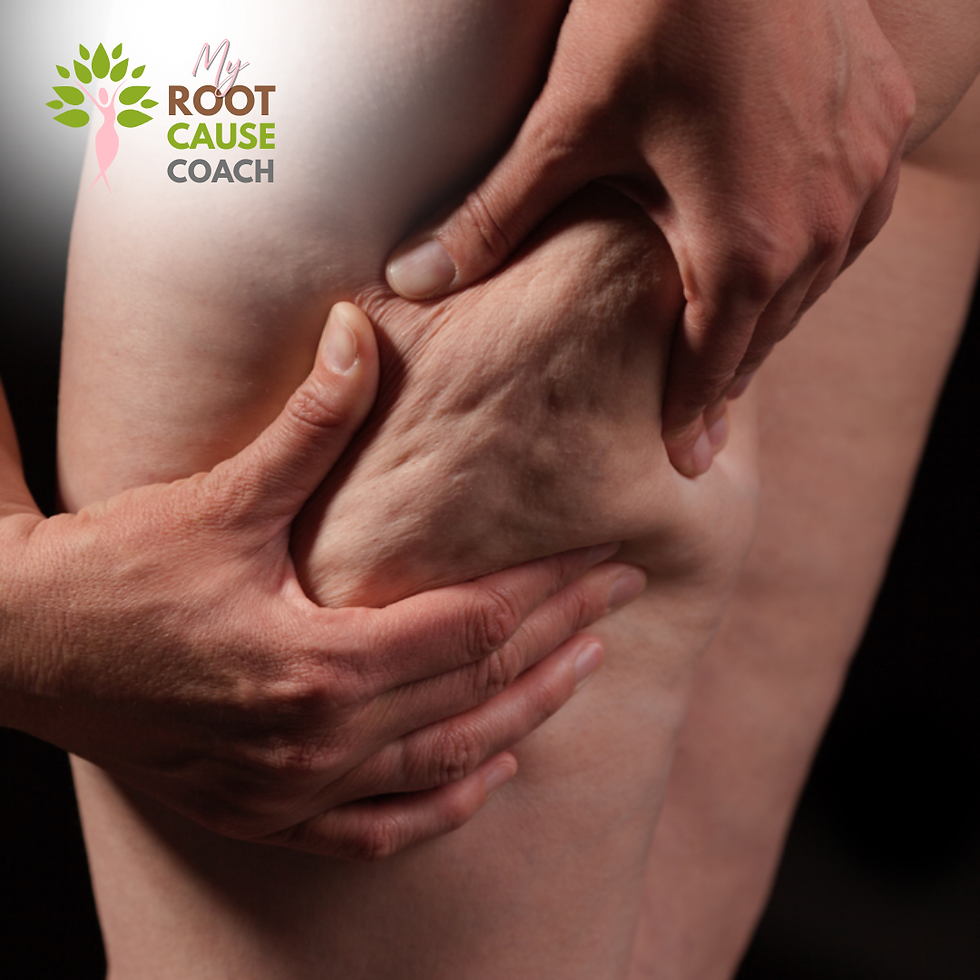
Cellulite is what happens when fat cells in the deeper layers of skin push upward against the skin's surface while fibrous bands of connective tissue pull downward, creating the characteristic dimpled or lumpy appearance. It most commonly appears on the buttocks, hips, and thighs, which are areas of the body where women are hormonally designed to store fat. This is not incidental. It is biology.
The structural reason women experience cellulite more than men comes down to the architecture of connective tissue. In women, the fibrous bands that connect skin to underlying muscle run in parallel vertical columns. In men, those same bands form a tighter crosshatch pattern that holds fat more firmly in place beneath the surface. This is why a man and a woman can have identical body fat percentages and the woman will still show more visible cellulite. It is not a function of effort or discipline. It is anatomy.
Cellulite is also classified in stages, from stage one, where dimpling is only visible when the skin is pinched, to stage four, where pronounced raised areas and deeper dents are visible at rest and may even be accompanied by tenderness. Most women move between stages over the course of their lives depending on a combination of factors, some of which are fixed and some of which are genuinely addressable.
The Root Cause Drivers Worth Understanding
Here is where the conversation gets more interesting than most cellulite content allows it to be.Genetics plays a real role, and research suggests cellulite may be more common in certain populations due to inherited differences in connective tissue structure, fat distribution, and circulation patterns. You cannot change your genetics, but understanding that your baseline is partly inherited can be a meaningful release from the belief that cellulite is something you created through poor choices.
Hormones, particularly estrogen, are central to cellulite development and progression. Estrogen influences fat distribution, connective tissue integrity, and circulation all at once, which is why cellulite tends to appear or worsen during hormonal transitions like puberty, pregnancy, perimenopause, and menopause. It is also why women who use hormonal birth control or hormone therapy sometimes notice changes in cellulite visibility. Estrogen dominance, a state in which estrogen is elevated relative to progesterone, is increasingly common in modern women due to environmental estrogens (xenoestrogens) found in plastics, personal care products, and certain food packaging, and it can exacerbate the hormonal contribution to cellulite by promoting fat storage and weakening connective tissue.
Collagen is the protein that gives skin its thickness, firmness, and elasticity. As collagen production declines with age, typically beginning in the mid-twenties and accelerating after menopause, skin becomes thinner and less able to mask the fat and fibrous band structure beneath it. This is why cellulite tends to become more visible with age even in women whose body composition hasn't changed significantly. Supporting collagen production through nutrition, specifically adequate protein intake, vitamin C, and the amino acids glycine and proline found in bone broth and collagen-rich foods, is one of the most evidence-adjacent strategies for maintaining the skin thickness that helps keep cellulite less visible over time.
Circulation and lymphatic flow matter more than they get credit for in this conversation. Poor circulation reduces the delivery of oxygen and nutrients to the connective tissue in areas prone to cellulite, while sluggish lymphatic drainage allows metabolic waste and fluid to accumulate in the same areas. The lymphatic system has no pump of its own. It relies entirely on muscle movement, deep breathing, and hydration to keep things moving. A sedentary lifestyle, chronic dehydration, and tight clothing that restricts circulation all contribute to the stagnation that makes cellulite more pronounced.
Chronic inflammation and diet are connected to cellulite in ways that the standard "eat less, exercise more" conversation doesn't fully address. A diet heavy in ultraprocessed foods, refined carbohydrates, and inflammatory seed oils promotes the kind of systemic inflammation that degrades collagen, weakens connective tissue, and disrupts the hormonal balance that governs fat storage. It also tends to drive blood sugar dysregulation and insulin resistance, both of which promote fat accumulation in estrogen-dominant storage areas, which are exactly the areas where cellulite is most common. This is not about blaming diet for the existence of cellulite. It is about recognizing that the inflammatory environment created by modern eating patterns can amplify a structural feature that was always going to be present.
Dehydration deserves a specific mention because it is both extremely common and extremely underappreciated in its effect on skin appearance. When skin is chronically under-hydrated, it loses plumpness and becomes less able to smooth over the structures beneath it. The dimpling that might be barely visible in a well-hydrated state becomes more pronounced when the skin itself is depleted. This is one of the simplest, lowest-barrier interventions available and one that most people are genuinely not doing adequately.
What Actually Helps, Honestly
I want to be straightforward with you the way I always try to be: there is no treatment, topical, device, or lifestyle change that permanently eliminates cellulite. Anyone selling you that outcome is misleading you. What exists is a range of approaches that can reduce its visibility to varying degrees and for varying lengths of time.
Medical procedures including laser treatment, subcision, acoustic wave therapy, and vacuum-assisted tissue release have shown meaningful results in clinical studies, but the effects are typically temporary, require repeat treatments, and carry costs that most people cannot sustain long-term. These are reasonable options if cellulite is causing you genuine distress, and a board-certified dermatologist can help you evaluate whether they make sense for your situation.
Topical products with caffeine or retinol have the strongest evidence among over-the-counter options, but the emphasis has to be on consistent, long-term daily use. Caffeine temporarily constricts blood vessels and reduces the appearance of fluid accumulation in the area. Retinol, used consistently over months, can modestly thicken the skin and improve its ability to mask underlying structures. Neither of these is a dramatic fix, but both are legitimate tools when used with realistic expectations.
From a root cause standpoint, the interventions most worth investing in are the ones that address the upstream drivers simultaneously. Strength training is the single most effective lifestyle intervention for reducing cellulite visibility because building lean muscle in the areas affected literally changes the structure beneath the skin, reducing the proportion of fat relative to muscle and creating a firmer surface. This is not about losing weight. It is about changing body composition, and the two are not the same thing. A woman can lose weight and still see more cellulite if she loses muscle along with fat. Resistance training preserves and builds the muscle that serves as the foundation under the skin.
Supporting collagen through diet and targeted supplementation, specifically hydrolyzed collagen peptides, vitamin C, and adequate dietary protein, gives your skin the building blocks it needs to maintain thickness and elasticity as you age. Managing estrogen load by reducing xenoestrogen exposure, supporting liver detoxification, and eating a diet high in fiber to support estrogen metabolism through the gut are less commonly discussed but genuinely meaningful levers. Staying hydrated, moving regularly to support lymphatic circulation, and reducing the chronic inflammatory inputs from ultraprocessed foods address the background conditions that make cellulite more pronounced than it would otherwise be.
The Bottom Line
Cellulite is not a failure. It is not a health problem. It is a structural feature of the female body that is present in nearly every woman and that reflects a combination of genetics, hormones, anatomy, age, and lifestyle in proportions that vary enormously from person to person.
What the root cause lens adds to this conversation is not a promise to eliminate it. It is the understanding that your body is always communicating something, and that a shift toward lower inflammation, better hormonal balance, stronger connective tissue support, and improved circulation will not just change how your skin looks. It will change how your body feels, functions, and ages across every system, not just the surface.
The women I work with who stop chasing the elimination of cellulite and start investing in the upstream conditions of their health almost universally report that their skin looks better as a secondary benefit of feeling dramatically better overall.
That is the root cause approach in action. The goal was never the dimple. The goal was the whole person.

If you would like more guidance or support, call or text Cami Grasher, Root Cause Health Coach, at (214) 558-0996 for a discovery call.
You can also book online by clicking the button below to choose a day and time that works best for you.
Cami Grasher is a Root Cause Holistic Health Coach and Certified Traditional Naturopath. She works with clients to identify and address the underlying hormonal, neurological, inflammatory, and metabolic drivers of chronic conditions.
*This article is for educational purposes only and does not constitute medical advice.


Comments